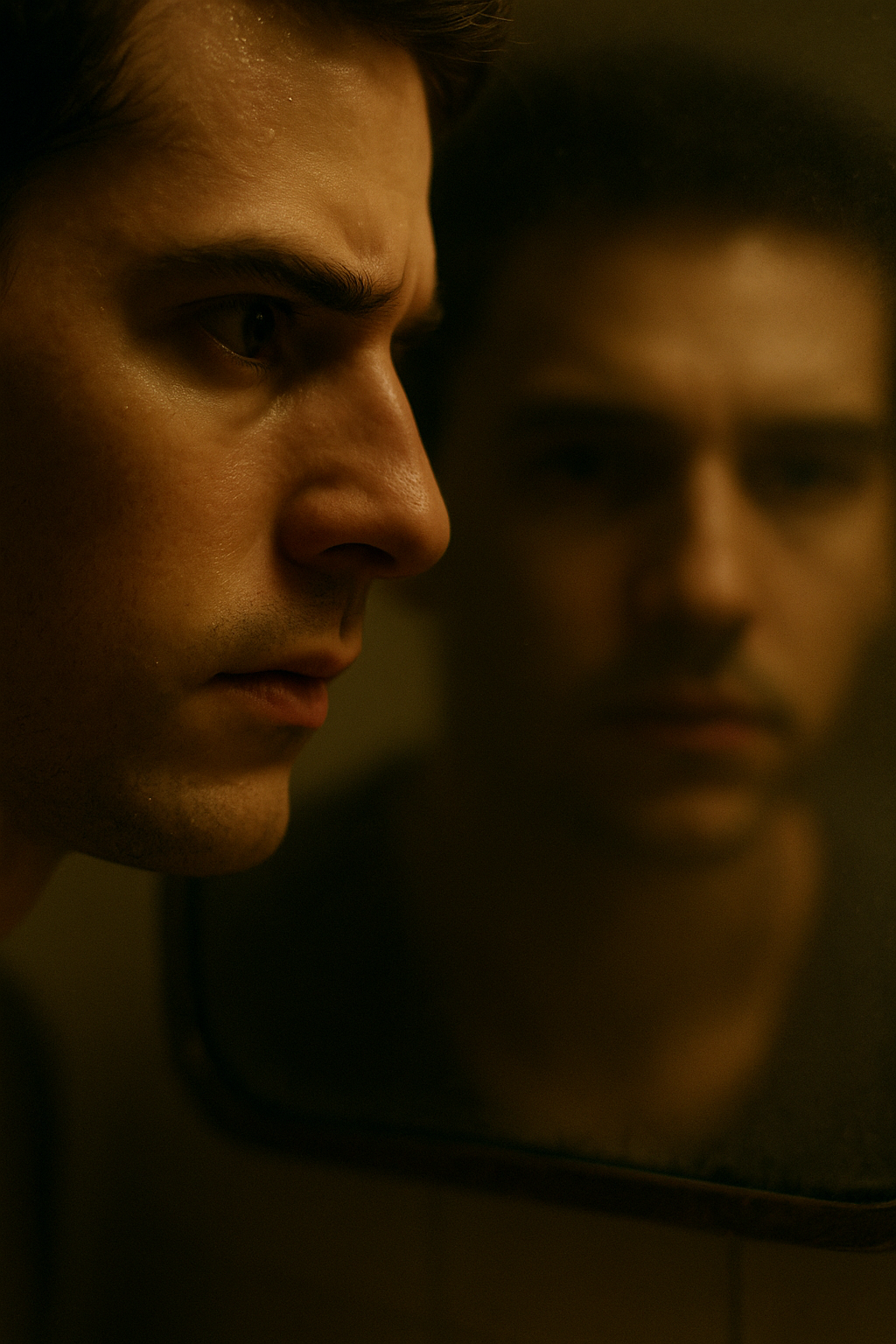
There is a peculiar moment when you stand before a mirror and catch yourself in the silent dialogue between who you are and who you think you should be. It isn’t about the surfacethe way light hits a cheekbone or how a crease falls beneath an eye. It is about something deeper, quieter, a boundary drawn without words between inward truth and outward illusion. Mirrors do more than reflect; they reveal the invisible walls we set around ourselves when no one else is watching.
A Quiet Audience of Self and Shadow
When you look in a mirror, you invite a part of yourself into a space it rarely occupies: the role of observer and observed at once. It’s not vanity that draws you there, but something more complex and subtle. The mirror creates a stage where your private self can pause and take stock. Without the noise of other people’s expectations, the roles you playfriend, colleague, loverall dissolve, leaving just a raw, unscripted moment with yourself.
This moment can feel strange because it exposes an unspoken tension. You become aware of the difference between the person rehearsing in the reflection and the person truly standing there in the room. It is a sliver of vulnerability wrapped in silence. When no one else watches, the mask relaxes, but something else comes forwardthe careful negotiation of how much of yourself you allow to be seen, even to your own gaze.
The Mirror’s Quiet Reckoning with Boundaries
Mirrors do not lie, but they don’t tell the whole story either. What they do is show the borders you set for yourself. This is not just about physical appearance or surface flaws. It is the pause before a smile that reveals if you will soften or resist. It is the tightening of a jaw that signals what boundaries you are unwilling to cross. The mirror frames these subtle negotiations in a silent confrontation.
We carry these boundaries not just to protect ourselves from harm, but to preserve a sense of dignity. Behind the mirror’s gaze, we calculate where to hold back and where to push forward. It’s a private strategy session where our identity is both constructed and questioned. In this light, the mirror becomes less about reflection and more about resistanceresistance to being overwhelmed by roles or chaos. It reminds us who we owe loyalty to, often ourselves.
A Stage for Emotional Truths
The mirror’s gaze is cinematic in its quiet drama. The room is hushed, the lighting imperfect. You watch the flicker of emotion pass through your eyesanxiety, resolve, embarrassment, or quiet pridewithout the masks worn for public consumption. It is a moment that unfolds with an almost unbearable honesty.
We often think of our identity as fixed, but here we see its fluid edges. What feels like a single self is really a cast of inner characters: the critic, the protector, the dreamer. Near a mirror, these voices are not shouted over by the world, but whispered into focus. The result is a fractured, nuanced self-portrait that defies easy categorization.
This experience reveals a quiet courage. It is not the brashness of confrontation but the gentleness of acceptance. To face oneself unguardedeven brieflyis a kind of intimacy many never cultivate outside the privacy of that reflective glass.
The Hidden Self: Who We Allow Ourselves to Be
In front of a mirror, there is a subtle but profound distinction between who you are and who you allow yourself to be. The mirror cannot invent new truths for you; it only magnifies the choices you have already made. Each hesitation or firm line speaks of compromises, of self-respect negotiated in real time. Sometimes we shrink, folding ourselves into smaller shapes for safety. Other times we stretch, testing the limits of what might be possible.
This is where the mirror’s quiet power lies: in its refusal to be complicit in denial. It asks you to confront not just surface imperfections but the interior rules that govern your life. We hide so much behind our reflectionsfear, desire, shamebut also hope and resilience. The mirror holds all of this, steady and unflinching.
Living Beyond the Looking Glass
When you step away from the mirror, you carry something with you. It is not a perfected image but a renewed sense of self-awareness. The boundaries glimpsed there guide you through the day’s interactions and decisions. The mirror’s gaze may be private, but its impact is public: it shapes the integrity with which you move through the world and the respect you claim for yourself.
To live with these reflections means to accept complexity, to embrace the tension between vulnerability and strength. It calls for a tenderness toward oneself that is often harder to muster than kindness toward others. And it frees you from the endless performance, offering instead a quieter, more honest way to be seen.
In the end, our relationship with the mirror is a metaphor for our relationship with ourselves. Quiet, unsettling, necessary. It challenges us not to hide but to meet our own gaze without flinching. It invites us to hold our boundaries gently, not as armor but as a declaration of self-respect.
This article is intended for reflection and entertainment purposes only.