
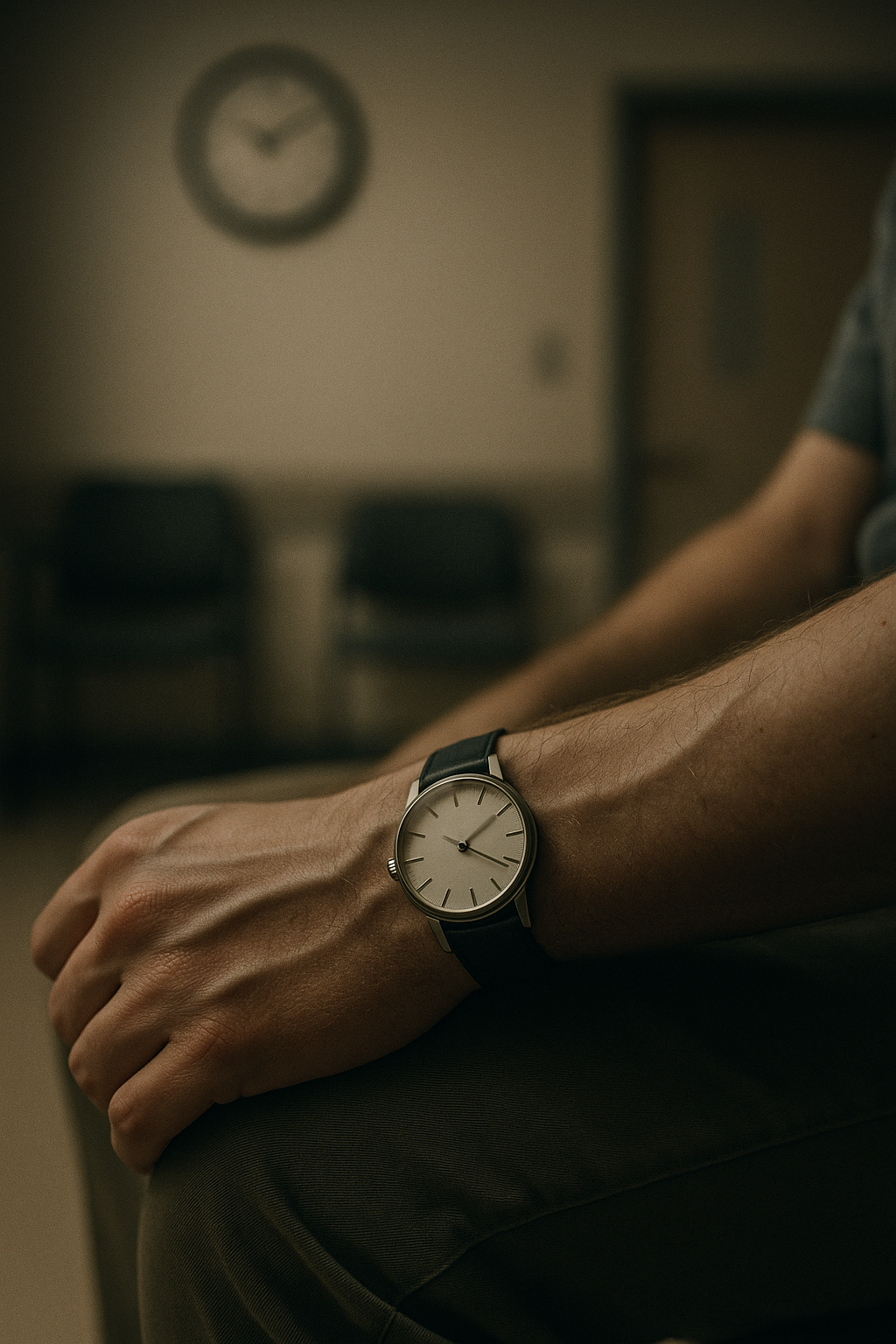
There’s a peculiar kind of suffering that shows up in waiting rooms. It’s quiet but heavy. You sit, your mind jumps forward, your body tightens, and time seems to twist itself into something thick and sticky. The familiar ticking of the clock becomes a drumbeat for nervous thoughts, and you’re caught somewhere between stillness and storm.
The Ancient Brain’s Alarm System
Before smartphones or calendars, before we had schedules or estimated wait times, humans relied on more immediate signals. Our brains developed in worlds where unknown meant danger. Silence wasn’t just quietit was a hint of lurking threat. Waiting, for our ancestors, might mean watching for predators or enemies. This made our nervous systems highly attuned to uncertainty.
Today, waiting rooms feel strange because they awaken that ancient warning system. The dull buzz of fluorescent lights, the sterile chairs, the faint rustle of magazinesit’s a setting designed to hold people still and silent. But inside, your brain is anything but still. It tries to read every subtle cue, every unspoken possibility, light flickers of threat under soothing fluorescent light.
Your body reacts even if your mind tries to stay calm. The tightness in your chest, the faint sweat on your palms, the restless tapping of your footthese are echoes of a nervous system ready to leap into action, waiting for the signal that might never come.
Time Without Meaning
In waiting rooms, time becomes a strange companion. Minutes no longer flow evenly. Each second seems heavier or lighter depending on your worry. When you’re waiting to hear news that mattershealth updates, interview results, or a loved one’s arrivaltime loses its usual rhythm.
The clock on the wall isn’t a neutral observer. It becomes a silent judge measuring your patience against your growing unease. Your mind races to predict what’s next but finds no clear answer. Without control or clarity, the wait distortsmoments stretch in painful slow motion.
Our perception of time is tied deeply to what’s happening inside us. Anxiety doesn’t just fill your thoughts. It rewires your experience of the present. That subtle pressure beneath your skin grows, sensing the tension before words or explanations. The body knows before the brain fully understands, and that recognition can feel isolating.
The Weight of Unknowns
Some spaces carry a particular kind of invisible weight. Hospitals, legal offices, social services centerswaiting rooms in these places feel different than a coffee shop queue or a friend’s doorstep. The design itself, sometimes unintentionally, signals formality and finality. The chairs are stiff, the colors muted, the air recycled.
This environment presses on the senses. The sterile scent, the low murmur of distant conversations, even the placement of an extra chair against the wall becomes part of a larger narrative your unconscious mind constructs. It’s a story about vulnerability, uncertainty, and powerlessness.
In these spaces, anxiety doesn’t just arise from thoughts or worries. It emerges from the body’s ongoing conversation with its surroundings, from subtle but constant cues that activate your defensive systems. The waiting room becomes a stage where your mind and body play out their response to the unknown.
Anticipation Sharpens, Not Soothes
Waiting is often mistaken for a pause or rest. We expect a kind of mental settling when nothing happens. But that’s rarely true in uncomfortable waits. Instead of quieting the mind, anticipation often sharpens it.
As seconds tick by, your body remains vigilant, and your brain amplifies “what if” scenarios. The ambiguity sets off a cascade of internal alarmssmall physiological changes that escalate tension: the quickened heartbeat, shallow breaths, muscles tightening in the shoulders or jaw.
What’s most telling is that this response happens beneath conscious thought. You might tell yourself to relax, but your body is already preparing for whatever might come nextfight or flight kicking in quietly, out of reach of direct control.
Human Experience in the Stillness
Waiting rooms strip away distraction, leaving you face to face with your own anticipation. In their stillness, they expose a profound truth about human nature: our relationship with uncertainty is deeply entwined with both our biology and our social experience.
We carry in our bodies a history written not only by individual memory but by millennia of evolution. Our nervous systems are finely tuned to threats, and uncertainty is one of the oldest threats of all.
Yet, these moments also reveal resilience. People find quiet strength in those spacesshared glances, soft breathing, the small rituals of checking a phone or straightening a sleeve. The wait, while challenging, can also be a space where we learn how to occupy uncertainty without letting it consume us.
Closing Reflection
Next time you find yourself in a waiting room, remember that your nerves are not betraying youthey are doing what they have done for thousands of years. Your body is reading the space and the unknown with a sensitivity born of survival.
The anxiety isn’t just in your mind; it lives beneath your skin, in the rhythm of your heartbeat and the tension in your muscles. It’s a deeply human response to stillness, silence, and uncertaintyone that connects us through shared instinct even when we are alone.
And perhaps in that recognition, there is a different kind of comfort: the understanding that waiting rooms don’t just test our patience but remind us of our enduring humanity.
This article is intended for educational, reflection, and entertainment purposes only and is not medical advice.